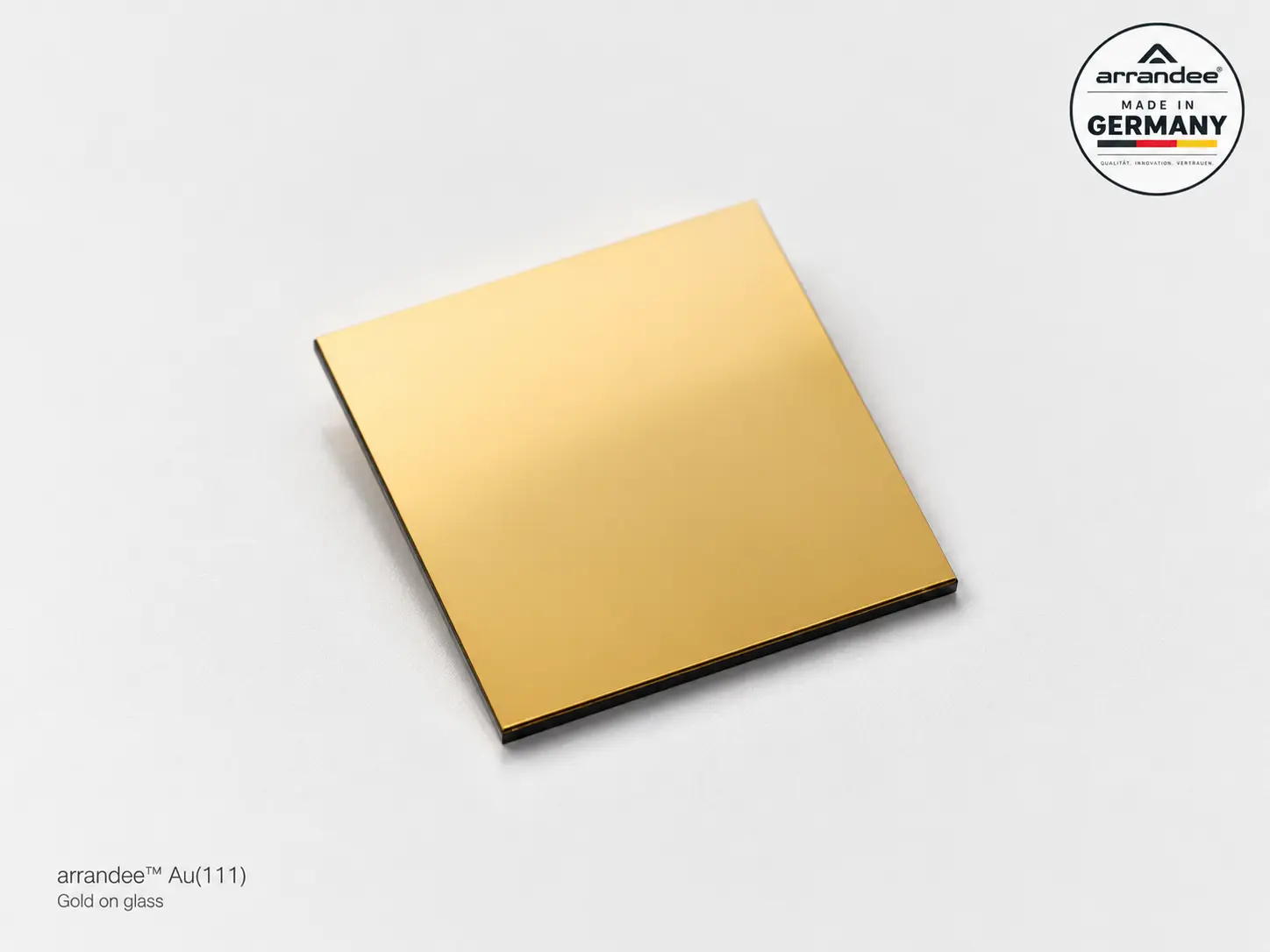
Gold on Glass (Au(111)) Substrates | arrandee™

From €25 per substrate
Delivery time: 1–2 weeks In Stock

This is the laboratory standard for atomic-scale scanning probe microscopy. Flame-anneal it and you get flawless, atomically flat Au(111) terraces several hundred nanometers wide.

99.999% Au· 11×11mm· ~250nm layer

12×12mm is currently unavailable – 11×11mm remains in stock. Inquiries for 12×12mm are still welcome.

Request a Quote Now Preparation Instructions
Made In-House in Germany
30+ Years of Experience Since 1994
Custom Sizes & Prototypes on Request

Product Description

Each arrandee™ Gold on Glass substrate is a 99.999% pure Au(111) gold film, roughly 250 nm ± 20 nm thick, deposited without an adhesion layer directly onto premium D263 borosilicate glass. It ships in the standard 11×11 mm format (glass approx. 0.7 mm thick) – the 12×12 mm format is currently unavailable, but inquiries are welcome. Substrates are packed in inert-gas-flushed glass tubes that protect the surface until you're ready to flame-anneal it. Custom sizes and coatings are available on request.

What These Substrates Are Used For

Most labs use our gold-on-glass substrates for scanning probe microscopy (SPM, AFM, STM), where the atomically flat Au(111) terraces give a clean, reproducible surface for imaging and molecular-scale measurements. They're just as common as the base for self-assembled monolayers (SAMs), and as working electrodes in electrochemistry such as cyclic voltammetry and EC-STM. In the life-science and bioengineering literature, the same product is sometimes described as a gold-coated microscope slide or gold-coated coverslip, used as a conductive, atomically smooth support for cell and biomolecule imaging. If you're weighing gold-on-glass against mica, single-crystal, or template-stripped gold, our substrate comparison guide walks through the trade-offs.

Technical Specifications

Precise parameters for demanding microscopic investigations

Base material Borosilicate flat glass (D263)
Adhesion layer None (adhesive-free physical metal vapor deposition to avoid contamination)
Gold purity 99.999% pure gold
Gold layer thickness ~ 250 nm ± 20 nm
Standard dimensions 11 x 11 mm (thickness approx. 0.7 mm) – 12 x 12 mm currently unavailable
Packaging Inert-gas-flushed glass tubes (protection against oxidation and hydrophobicity)
Availability In stock; usual delivery time approx. 1-2 weeks (expedited delivery available for urgent requests)

Typical Applications

  • Au(111) Substrates for STM: High-resolution scanning tunneling microscopy for imaging molecular structures.
  • Self-Assembled Monolayers (SAMs): Straightforward functionalization with thiol-based organic molecules.
  • Gold Substrates for Electrochemistry: Studies at the electrolyte/electrode interface.
  • Plasmonics & Biosensors: Substrate for SPR (Surface Plasmon Resonance) and SERS (Surface-Enhanced Raman Spectroscopy).

Your Advantages with arrandee™

  • Cost savings: Over 80% cheaper than bulk gold single crystals at comparable surface quality.
  • No polishing required: Because the atomic flatness is produced purely thermally, you skip the mechanical polishing step entirely and save lab time.
  • Adhesive-free deposition: No chromium or titanium adhesion layer, so there's no contamination risk during annealing.

Frequently Asked Questions (FAQ)

Answers about the use and properties of our Au(111) substrates

What is an Au(111) substrate?

An Au(111) substrate is an extremely thin, single-crystal-like oriented gold layer on a glass support. Because of the hexagonal packing of gold atoms in this crystallographic plane, heating the surface produces atomically flat terraces well suited to high-resolution scanning tunneling microscopy (STM) and atomic force microscopy (AFM).

Which gas is needed for flame annealing?

We recommend using a propane or butane gas flame (camping gas torch). Avoid an excess of oxygen, which would produce too hot a flame and risk melting the glass plate.

How long can the substrates be stored?

The adhesive-free manufacturing process and the sealed glass tubes mean the substrates are, in theory, shelf-stable indefinitely. In practice, gold surfaces pick up atmospheric oxygen and hydrocarbons over time, so we recommend annealing the substrate freshly in the lab right before use.

What sizes and pricing are available for Au(111) gold substrates?

Our gold-on-glass substrates are available in the standard 11x11 mm size, starting from €25 per substrate. The 12x12 mm size is currently unavailable, but inquiries are welcome. Custom sizes and coatings can be arranged on request.

Is gold on glass the same as a gold-coated microscope slide or coverslip?

Yes – "gold on glass", "gold-coated microscope slide", and "gold-coated coverslip" all describe the same underlying product: a thin, high-purity gold film on a glass support. Which term is used often just depends on the field: surface scientists tend to say "gold-on-glass" or "Au(111) substrate", while life-science and bioengineering labs more often say "gold-coated coverslip" or "gold-coated microscope slide".

Going Further

Self-Assembled Monolayers on Gold

How to prepare and characterize thiol-based SAMs on Au(111) gold substrates.

Read the Guide

Gold Substrate Comparison

Gold-on-glass vs. mica vs. single crystal vs. template-stripped gold, compared.

Compare Substrates

Cited in Published Research

A selection of peer-reviewed studies using arrandee™ Au(111) gold substrates

Nature Communications, 2025

Heat transfer in metallic nanometre-sized gaps

López-Nebreda, Agraït et al. · Universidad Autónoma de Madrid

Read the Paper
Nature Communications, 2025

Ion sensing based on frequency-dependent processes at electrode/electrolyte interfaces

Mohseni Armaki, Taheri et al. · TU Delft / Univ. of Groningen

Read the Paper
Nature Communications, 2021

Optoregulated force application to cellular receptors using molecular motors

Mechanobiology / molecular motor research team

Read the Paper

View All Publications

Trusted by Research Groups At
University of Zaragoza logo IBEC Institute for Bioengineering of Catalonia logo Bangor University logo Newcastle University logo Université libre de Bruxelles logo University of Namur logo